Happy 250th Birthday, America! When the founding fathers adopted the Declaration of Independence, they ushered in a new era of democracy, liberty and identity. And, fittingly, a distinctive American architectural style emerged.
Providing the young nation its own identity, Federal architecture evolved as a reflection of early American values and aspirations. A modern interpretation of Neoclassical architecture, it sought inspiration from the symmetry, balance and classic elements found in Roman architecture, and hoped to convey strength and stability and encourage civic pride.
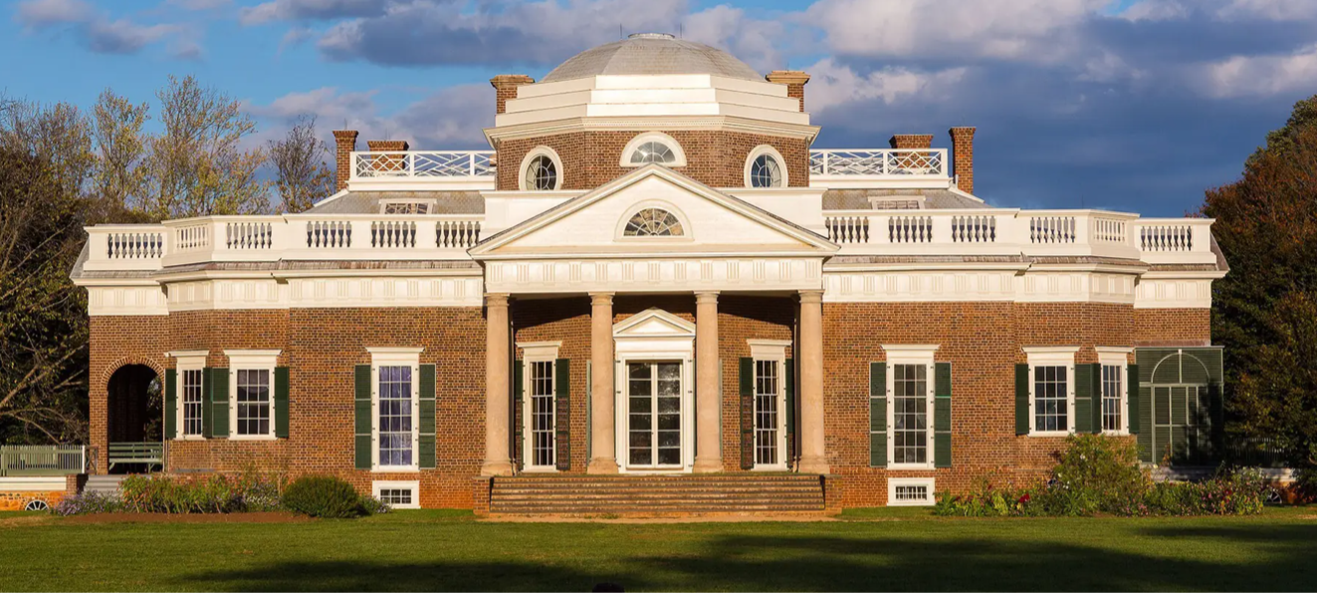
Image of Monticello, monticelo.org
Lighter and more refined than the previous Georgian or Colonial style, hallmarks of this new architectural approach include symmetrical facades, low pitched hip or gabled roofs, doorways or entryways framed with arched windows known as fanlights, porticos supported by slender columns, brick exteriors, and geometric or elliptical shaped rooms. Prominent architects of this period include Thomas Jefferson, Charles Bulfinch, Samuel McIntire, John Holden Green, James Hoban, Benjamin Latrobe, and Pierre L’Enfant.
US Supreme Court Photo by Tim Mossholder on Unsplash
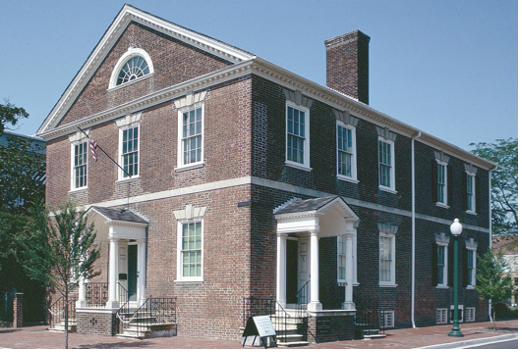
Moses Myers House Photo by Calder Loth/DHR, homedit.com
Although Federal and Neoclassical architecture share similar roots, they were typically applied at different scales and for different purposes. Neoclassical architecture was favored for monumental civic spaces and government buildings, where smooth stone or marble facades, grand porticos and imposing colonnades conveyed authority, permanence and democratic ideals. Federal architecture was primarily used on private residences and smaller public buildings. While Federal architecture was similarly grounded in classical principles of symmetry and proportion, it interpreted them with greater refinement, favoring red brick facades, evenly spaced taller windows, elegant fanlights and restrained ornamental detailing. Simply stated, Federal architecture is America’s version of the Neoclassical style.
In many ways, Federal architecture can be distilled into a distinctly patriotic palette of red, white and blue.
Image courtesy of antiquehomesmagazine.com
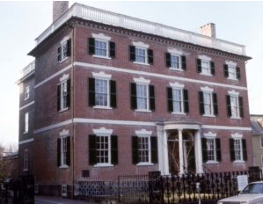
Red: The defining feature of many Federal homes was their warm red brick exterior. The rich masonry elegantly contrasted with the crisp white trim, creating a timeless sensibility that emphasized the building’s clean lines and balanced proportions.
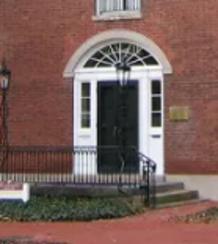
Fanlight at Decatur House, Washington DC, via streetsofwashington.com
White: Door surrounds, wooden roofline trims, window sashes and frames were typically finished in white, reinforcing the style’s emphasis on symmetry and classism. Front entrances often showcased delicate white columns, pediments or fanlights. Interior white moldings, baseboards, crown molding and fireplace mantels highlighted finely crafted architectural details.
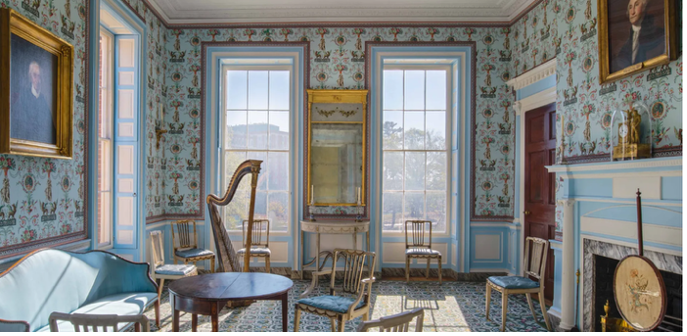
Interior of Homewood House, courtesy of worldofinteriors.com
Blue: The Federalist style also embraced a blue palette with shades such as Bulfinch blue, Citadel Blue and Meetinghouse Blue (historicnewengland.org). Dark hues, including navy, were commonly used on exterior shutters, while softer tones could be found in the interior spaces. Pale blue walls accentuated delicate plaster details, moldings and fireplace surrounds, and sky-blue ceilings created an airy and light atmosphere. Together, these colors emphasized a home’s craftsmanship, and reflected the homeowner’s sophistication, wealth, and affluence.
While Federal architecture can be seen throughout the country, it is most closely associated with Washington DC and New England, where many of the nation’s earliest public buildings and private residences were built.
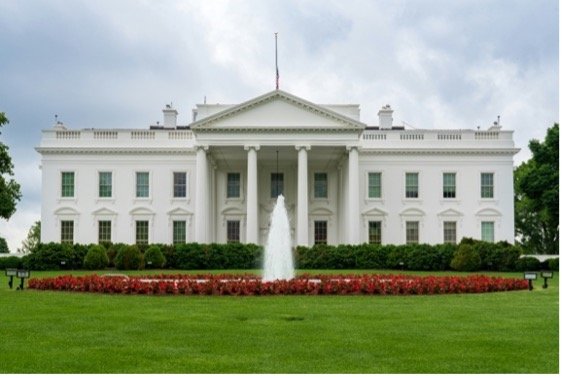
White House, Washington, DC
The Executive Residence, North Lawn Photo by Tomasz Zielonka on Unsplash
South Lawn Image by Kelsey Graczyk, via nps.gov
The most iconic example of Neoclassical architecture is the White House. Designed by James Hoban in 1792, it translates the principles of ancient Roman architecture - symmetry, balance and classical detailing – into an enduring symbol of American civic design. (Pre Trump-era renovations and recent alterations), the building’s façade exhibits exquisite symmetry, with evenly spaced windows and doors on either side of the central axis. Alternating triangular and curved pediments sit above the main floor windows, adding rhythm to the composition, while the North and South porticos feature stately, majestic columns reminiscent of classic temples. Restrained ornamentation, subtle stone surfaces and delicately carved details emphasize the building’s elegant proportions. Geometric forms continue in the interior, most notably the Oval Office, the White House’s premiere elliptical space. Other rooms that showcase this preference towards geometry include the Diplomatic Reception Room, the Blue Room and the Yellow Oval Room. Built from sandstone, the “President’s House, as it was originally called, was coated with whitewash, hence its famous nickname (History.com).
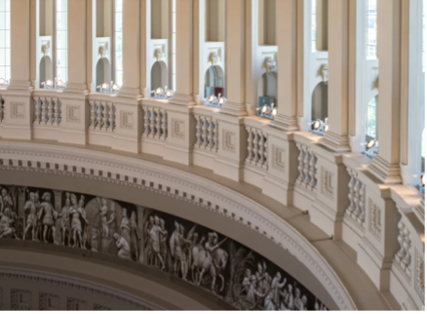
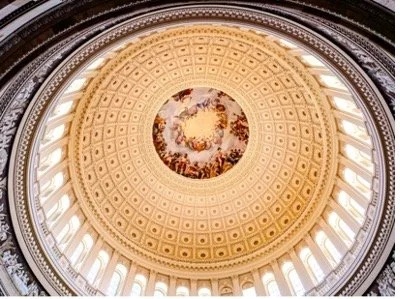
US Capitol, Washington DC
Photo by Alejandro Barba, Unsplash
Image courtesy of aoc.gov
Photo by Sebastian Schuster, Unsplash
First built in 1793 by William Thornton and rebuilt by Benjamin Latrobe after the 1814 fire, the US Capitol displays distinctive elements of Neoclassical architecture. Its symmetrical design, grand columned porticos and marble facades were intended “to inspire ancient civic virtues among Americans” (capitolhistory.org). At the heart of the building is the Rotunda designed by Bulfinch and inspired by the Pantheon, with curved walls, columns and friezes. It is crowned by Thomas Walter’s impressive 288-foot cast-iron dome. Painted white to blend with the marble exterior, the double-shell features The Apotheosis of Washington fresco within the oculus, and the dome is topped by the Statue of Freedom, creating one of the most recognizable silhouettes in the American skyline (aoc.gov).
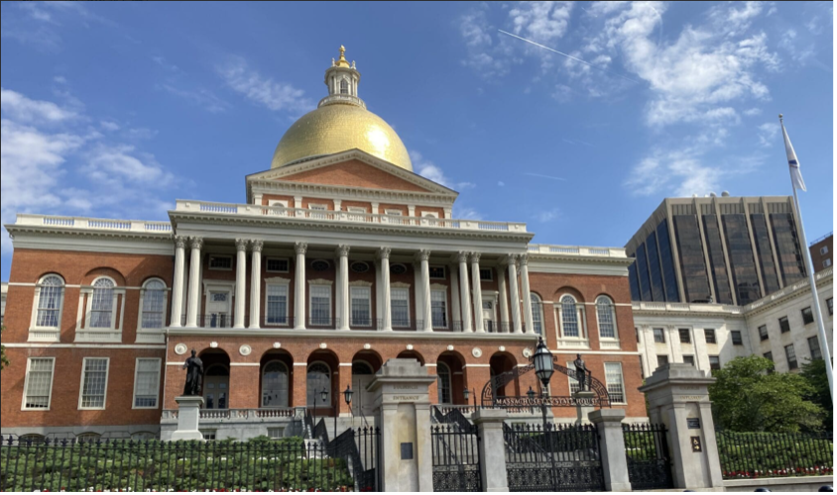
Massachusetts State House, Boston, MA
Image courtesy of evergreene.com
Designed by Charles Bulfinch in 1798, the Massachusetts State House famously features a golden dome. The dome was originally made of wood, later covered in copper by Paul Reveree’s company, and then gilded with gold leaf (evergreene.com). In keeping with Federal and Neoclassical style architecture, it is built with red brick, features a grand portico with graceful white columns and grand interior halls. Over the years, the additions and expansions have maintained the building’s original symmetry and clean lines.
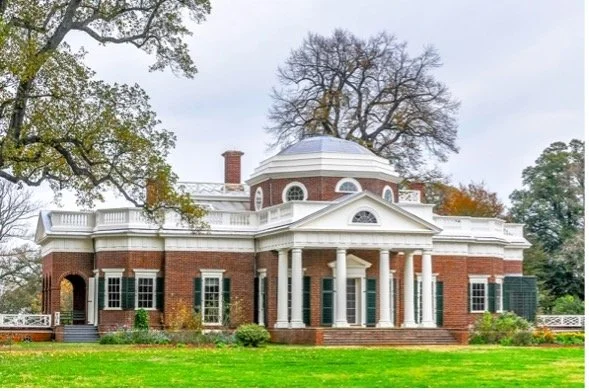
Monticello, Charlottesville, VA
Photo by Richard Hedrick on Unsplash
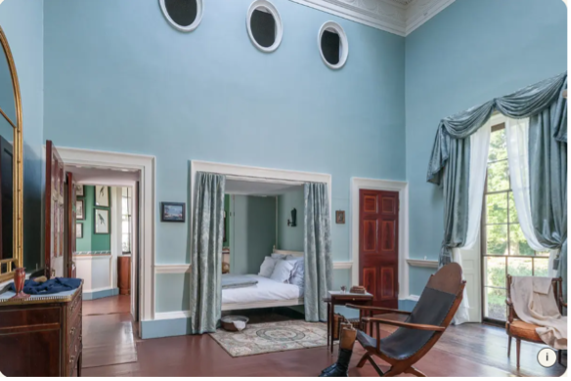
Alcove beds in Jeferson’s blue bedroom, Monticello.org
Over the four decades that Thomas Jefferson designed, expanded and renovated his Virginia estate, Monticello became a masterful fusion of Federal and Neoclassical architecture, deeply influenced by the work of Italian Renaissance architect Andrea Palladio. The house is symmetrical, featuring a two-story portico with Doric Columns supporting a triangular pediment. Flanking the house on either side are two wings or “dependencies” connected to the main house by a covered walkway concealing the domestic operations. Monticello’s most striking feature is its octagonal dome – the first to be used in a private residence. True to the Federal style, the warm red brick exterior is offset by the white trim and dark shutters. Jefferson also incorporated an array of architectural innovations: alcove beds conserved floor space, skylights allowed natural light, adjustable shutters that provided shade, improved ventilation and protected the window glass. He even had a mechanical dumbwaiter (Monticello.org).
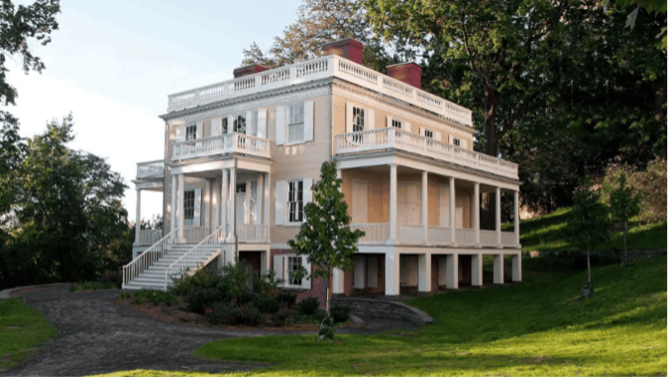
Hamilton Grange, New York, NY
Image courtesy of thestylesaloniste.com
Architect John McComb Jr designed Alexander Hamilton’s country estate in upper Manhattan, a quintessential example of Federal architecture distinguished by its symmetry and balanced composition. The careful arrangement of the windows, chimneys, doors, porches and balustrades creates a harmonious façade, while an elegant entrance is framed by slender columns and a delicate fanlight. While the exterior structure is a square shaped plan, the home features two distinctive octagonal rooms which served as the parlor and dining rooms. Enhanced natural light and cross ventilation occurs through carefully placed windows. The two-story home is elegant but restrained with understated ornamentation and classic detailing (vibenyctours.com).
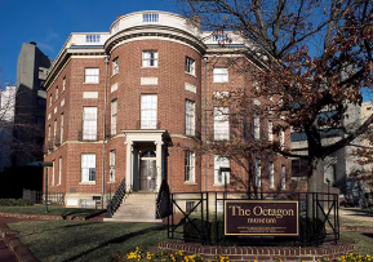
The Octagon House, Washington, DC
Image courtesy of nps.gov
The oldest private residence in Washington DC, The Octagon House was built by William Thornton (first architect of the US Capitol) for a wealthy Virginian businessman and later served as the temporary home for President Madison while the White House was renovated after the British burned it down. The house is named for its distinctive shape, although the building on has six sides, not eight. Typical of Federal architecture, the exterior is characterized by clean lines, red brick façade and columned portico, while the interior showcases a dramatic elliptical central staircase, fine detailing in the plastering and moldings, fireplace mantels and trimmings. It was in the Octagon House’s circular upstairs office where President Madison signed the Treaty of Ghent ending the War of 1812 (miles2gobeforesleep.com).
Today, Federal architecture is recognized for its beauty and cultural significance in American history. Wonder what the next 250 years of architectural innovations will look like….
Happy July 4th!